To address the lack of available industrial land hindering Kalgoorlie-Boulder’s economy, the City of Kalgoorlie-Boulder (CKB) and the Goldfields-Esperance Development Commission (GEDC) undertook detailed studies to understand the industrial land capability of the region, and what critical steps would unlock this potential.
The subsequent concept planning and joint advocacy provided a strong business case for State Government investment, delivering much-needed industrial land to support economic diversification and new industry.
Project cost
$130,000
Just under $130,000 was allocated by the State Government to undertake the work, alongside in-kind input from both the CKB and GEDC.
Project timeframe
- The advocacy had been ongoing since 2018.
- The study commenced in mid-2020 and was completed in early 2021.
- The activation of various industrial land sites has been ongoing since.
What was the problem or opportunity being addressed?
Lack of available industrial land was a major obstacle in building and growing industries vital for Kalgoorlie-Boulder’s economy.
The CKB and GEDC had been actively engaging with State Government agencies to address industrial land supply and access for a number of years. This required a strong evidence base and investment case to understand the development constraints of the land identified in West Kalgoorlie.
How the project addressed the problem or opportunity
Studying industrial land supply through the Kalgoorlie Industrial Land Capability Assessment was an essential step towards achieving broader economic diversification and employment objectives for the region and State. The study involved:
- A desktop review of land tenure, planning, environmental, heritage, landform, and infrastructure services
- Identification of issues that could impact potential industry development
- Development of a Concept and Staging Plan for optimal industrial land uses
- Recommendations on options, costs, and timeframes to reduce development barriers.
The study intended to guide future public and private planning, providing clear pathways for industrial land development and streamlining planning processes.
In May 2021, the GEDC CEO presented the findings to the Industrial Lands Steering Committee, which was followed by a site visit to Kalgoorlie on 3 August 2021. The briefing included a summary of key findings and the concept plan.
Project outcomes
Through strong advocacy by the CKB and the GEDC, supported by the study’s evidence base, relationships with key government agencies were strengthened, highlighting the potential for industrial land activation in the Goldfields.
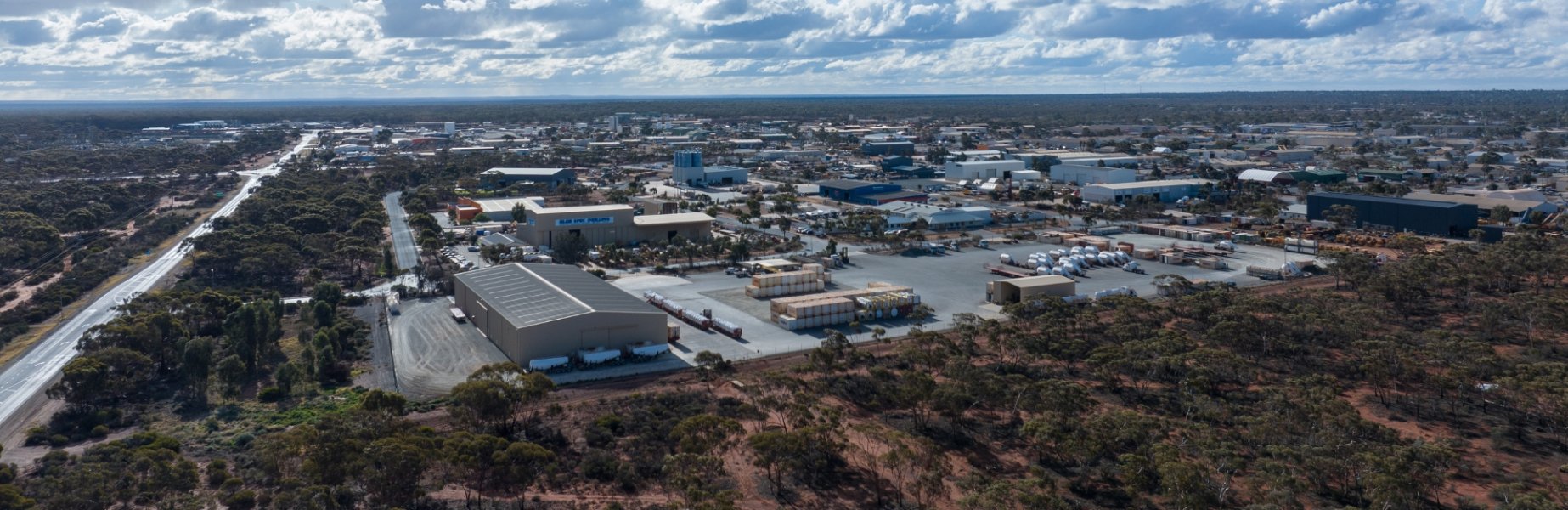
Key findings informed a Concept Plan identifying ‘Development Opportunity Areas’, suitable industries, and timeframes. Crucially, the site is near major mining activity in the Goldfields, offering a prime opportunity to become a hub for materials processing, logistics, and supporting industries.
Given the strategic regional importance of Lot 505, and to ensure stakeholders were actively engaged during the planning and development phase, a new Kalgoorlie Industrial Land Strategic Forum was established, chaired by GEDC with representation from CKB, Development WA, the Department of Planning, Lands and Heritage, and the former Department of Jobs, Tourism, Science and Innovation. The Forum continued in2025 as the Goldfields Industrial Lands Strategic Forum, supported by Development WA.
Key announcements since the study’s completion include:
- March 2021: State Government election commitment to activate Lot 350 (now Lot 505) for industrial development, following study findings
- May 2024: $500 million Strategic Industries Fund announced, with $20 million allocated to the Goldfields and South West
- January 2025: $20.8 million Yilkari Industrial Park Stage 1 announced, delivering more than 120 lots over 138 hectares. Stages 1-3 will support:
– $269 million in private investment and up to 800 construction jobs over 10 years
– 876 ongoing full-time jobs and $328 million in annual economic output.

Lessons learnt
- The study involved extensive data analysis, document review, and stakeholder consultation, and
- a primary lesson learnt was that advocacy on its own is unlikely to lead to serious investment decisions; however, building strong inter-government relationships founded on robust evidence and demand can drive decision-making and investment.