
Overview
The 2026-27 State Budget was handed down against the backdrop of an uncertain global economy. Despite this, the WA economy remains strong and continues to outperform the rest of the nation, which has helped to support its strong financial position.
The State Budget expects an operating surplus of $3.5 billion in 2025-26 and forecasts a budget surplus of $2.4 billion in 2026-27. Surpluses are also expected across the forward estimates. The operating surplus in 2025-26 was $1 billion higher than the projection from the Mid-year Review and was driven by higher taxation revenue and royalty revenue, partially offset by higher employee costs.
As a result of the State’s record asset investment program, general government net debt is forecast to increase from $26.2 billion in 2025-26 to $30.1 billion in 2026-27. Thereafter, net debt is expected to increase marginally over 2027-28 and 2028-29 to a high of $33.2 billion before decreasing to $31.2 billion in 2029-30.
The state economy is expected to grow overall by 3.25% in 2025-26, up from 1.3% in 2024-25. The economy is expected to grow by a further 2.25% in 2026-27, driven by strong dwelling investment, household consumption and resource exports.
Household consumption is expected to remain strong, growing at an estimated 2.75% in 2025-26 and 2026-27, driven by strong property prices, continued population growth and rising disposable incomes. Household demand is forecast to stay between 2.5% and 2.75%, which is notably above the 10-year average annual growth rate of 2.2%.
Dwelling investment grew by 9.5% in 2025-26 in line with the focus on addressing the State’s housing challenges, driven by both new dwelling construction and improvements to existing dwellings.
Expected growth in net exports are 3.0% in 2025-26 and 2.5% in 2026-27, driven by rebounding iron ore and lithium exports and strong agriculture exports.
Western Australia's labour market remains strong; however, employment growth is estimated to slow to 1.5% in 2025-26 then stabilise following high employment growth in the post-pandemic years. The unemployment rate is forecast to increase from an estimated 4% in 2025-26 to 4.25% in 2026-27, however this remains well below the long-term average.
The sharp increase in fuel prices in recent times has meant that inflation is estimated to increase, with the Perth CPI expected to rise by 5.5% in 2025-26, up from 2.8% in 2024-25. The CPI is then expected to slow to 3.75% in 2026-27 in line with an expected easing to the fuel markets. While inflation is expected to moderate over the forecast period, recent developments raise the risk that underlying price pressures may remain broader and more persistent than anticipated. If these pressures increase, inflation nationally may remain elevated for longer.
The outlook for fuel prices and inflation will be an important input to the Local Government Cost Index, which is expected to be revised upwards in the June Quarter edition of the WALGA Economic Briefing.
Fees and Charges
The State Budget contains estimates for a range of State Government regulated tariffs, fees and charges.
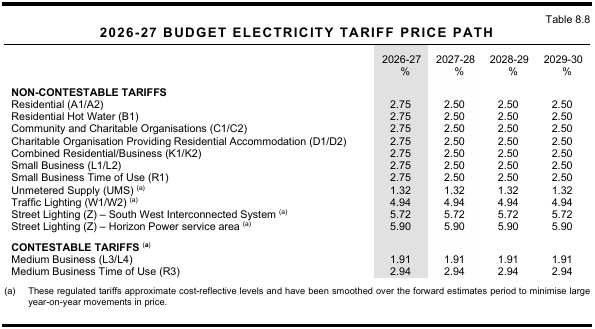
The price path for non-contestable electricity tariffs for Unmetered Supply (UMS) has increased from -0.13% in 2025-26 to 1.32% in 2026-27 and Traffic Lighting (W1/W2) has remained constant at 4.86% from 2025-26 to 2025-26.
Street Lighting (Z) in the Horizon Power service area has stayed the same at 5.90% across the forward estimates, whilst Street Lighting (Z) in the South West Interconnected System has seen its price path increase from 5.54% in 2024-25 to 5.72% in 2025-26.
Key water consumption, wastewater and drainage tariffs for metropolitan and country customers will increase 2.75% in 2026-27. Household water, wastewater and drainage tariffs are expected to increase by 2.5% per annum from 2027-28 onwards.
Households will see an estimated increase of 2.75% across electricity, water, wastewater and drainage charges. Public transport fares are estimated to decrease by 18.2% due to the lower Go Anywhere Fare introduced on 1 January 2026. Motor vehicle costs are expected to increase by 3.4% driven by vehicle licence charges increasing by 3.9%. The increases in tariffs, fees and charges are offset by the $100 per driver fuel support payments. Total expenditure by households is expected to decrease by 3.3% driven largely by the fuel support payments.